Rafael Henrique/SOPA Images/LightRocket via Getty Images
Facebook regularly deals with accusations of anti-conservative bias, but a new report suggests it may have been particularly forgiving. Washington Postsources say Facebook has limited punishment for Donald Trump allies who repeatedly violate rules against misinformation, in some cases removing strikes that could have led to reduced News Feed distribution or even bans. The social network pulled a repeat infraction claim against Donald Trump Jr. on Instagram due to fear of a “backlash” from the penalties that would follow, according to the reported insiders.
Other Trump family members also had strikes removed, the sources said. A pro-Trump PAC (America First Action) and other organizations that have repeatedly posted known false information also appeared to have escaped consequences. Facebook said it would label some posts that break its rules, but the Post found examples of clearly false claims from Rush Limbaugh, Gateway Pundit and others that hadn’t received those disclaimers.
Facebook spokeswoman Andrea Vallone didn’t directly challenge the report, noting the social media giant wouldn’t penalize accounts in “rare cases” when a rating wasn’t “appropriate or warranted.” The representative stressed that “many” pages the Post found had been punished for spreading falsehoods, but declined to say how or what the thresholds were to avoid opportunities for “gaming the system.”
If accurate, the exceptions wouldn’t be surprising. Like Twitter and other internet heavyweights, Facebook is aware that Trump and Republicans currently hold power that could lead to regulation and other legal action. Trump’s order demanding a rethink of the Communications Decent Act’s Section 230 is widely considered retaliation against Twitter for fact-checking one of his posts, and Facebook itself caught flak from Senate Republicans for limiting a New York Post story making hotly disputed allegations against Joe Biden’s son Hunter.
Stlll, this isn’t going to help quiet accusations that Facebook has separate standards for different people and groups. Critics have contended that Facebook is allowing misinformation to spread as a consequence, and that it shouldn’t have to fear retaliation when allegations of free speech violations haven’t held up in court. Its bid to please both sides of the American political discourse may have ultimately stoked tensions.
Facebook is finally testing a dark mode in its mobile app beyond a handful of users. The social network has teamed up with code sleuth Jane Manchun Wong to confirm that it’s publicly testing dark mode on Android and iOS. Just who’s getting the option isn’t clear, but MacRumorsnoted that many more people were reporting access to the night-friendly option.
If you have the option, you’ll see a Dark Mode button in the Settings & Privacy section under the Menu tab. You can force it on or off, or leave it up to your system-level settings. If you have an OS-level dark mode switch on when the Sun goes down, Facebook can follow suit.
The feature has been a long time in coming. Facebook let users opt in to a dark mode on desktop back in March, and companion apps like Messenger have had the choice since 2019. It’s not certain why the core Facebook app is getting this feature so much later, but the wait suggests it was determined to tread carefully given the sheer importance of an app likely used by billions of people.
Facebook’s and Twitter’s CEOs, Mark Zuckerberg and Jack Dorsey, have voluntarily agreed to attend a Senate Judiciary Committee hearing on November 17th. According to the committee’s announcement, the social media bigwigs will be there to testify on their “platforms’ censorship and suppression of New York Post articles.” The announcement comes a day after Republican Senators voted to subpoena the executives so they can respond to censorship accusations.
In mid-October, the social media platforms took action to limit the spread of a New York Post story that claimed to have obtained unflattering emails from the laptop of Joe Biden’s son. The publication provided little evidence for the claims made in the article, and at least one expert pointed out all the red flags that put the emails’ authenticity into question.
Facebook said at the time that it was reducing the story’s distribution until it had been reviewed by the company’s fact checking partners. A spokesperson explained that it’s “part of [the company’s] standard process to reduce the spread of misinformation.” Meanwhile, Twitter completely blocked the story’s URL from being shared via tweets and direct messages, citing its existing policies around hacked materials. The steps the platforms took reignited accusations that they have an anti—conservative political bias. As a result of the backlash, Twitter had to update its hacked materials policy and had to unblock the New York Post link.
In addition to discussing the companies’ response to the Post’s story, the committee will also take the chance to “review [their] handling of the 2020 election,” since the hearing is happening a couple of weeks after Election Day. Before the executives face the Senate to testify about news suppression, though, they first have to attend a hearing about Section 230 protections on October 28th.
Oculus’ move to require Facebook accounts is creating serious problems for some of its biggest fans. Windows Centralreports that Facebook is banning Oculus users who simultaneously use more than one VR headset linked to the same social network account. This violates Facebook’s terms of service, support representatives claim. In other words, you’re risking a ban if you buy a couple of Oculus Quest 2s for the family and don’t want to set up different accounts to let people play at the same time.
The company is planning on support for multiple Facebook accounts on one headset, but that doesn’t address problems for people who can’t or don’t want to create accounts, such as kids under 13. The current situation could force people to either create placeholder accounts or use only one headset at a time, potentially hurting some of Oculus’ most loyal users.
We’ve asked Facebook for comment.
The tech giant has claimed that the account requirement will help people find friends for social experiences like games, cut back on trolls, and allow integration features like the Horizon VR space. However, critics have argued that this ties users to the Facebook ecosystem and makes it easier for the firm to track users’ habits. These new reports won’t help Facebook’s case — it’s now harder to use Oculus headsets in a way that suits your household.
Update 10/25 6:15PM ET: Oculus has responded to the customer complaint in a series of tweets that using the same Facebook account on two headsets will not get the user banned. It also added that it plans to “introduce the ability for multiple users to log into the same device using their own Facebook account.”
Update 10/26 2:53 AM ET: The headline originally stated that Facebook would ban users with multiple Oculus devices, but Oculus stated that information is not correct. The headline has been updated with the correct information.
In August, Instagram repeatedly deleted a series of photos of Nyome Nicholas-Williams that showed the Black plus-size model with her arms over her bare chest. Nicholas-Williams argued that Instagram censored her while simultaneously allowing similar photos of thin, white women to stay up on the platform with little or no penalty. "Millions of pictures of very naked, skinny white women can be found on Instagram every day," shetold The Guardian at the time. "But a fat black woman celebrating her body is banned? It was shocking to me. I feel like I'm being silenced." Other Black, plus-size and marginalized creators found Instagram did the same with their photos, and the enforcement action led to a groundswell of online activism centered around the #IWantToSeeNyome hashtag.
A spokesperson for Instagram told The Guardian it had made a mistake when it deleted the photos. “As we looked into this more closely, we realized it was an instance where our policy on breast squeezing wasn’t being correctly applied,” they said. “Hearing Nyome’s feedback helped us understand where this policy was falling short, and how we could refine it.”
In a follow-up with Engadget, a spokesperson for Instagram said photos that show a person squeezing their chest, with a distinct change in the shape of the breasts, are still against the company’s rules. The company says it will continue to censor those to protect users under the age of 13. In instances where there might be some doubt, Instagram says it will instruct its reviewers to leave the content up.
“We are grateful to our global community for speaking openly and honestly about their experiences and hope this policy change will help more people to confidently express themselves,” Carolyn Merrell, global head of policy programs at Instagram, told Engadget. “It may take some time to ensure we’re correctly enforcing these new updates but we’re committed to getting this right.”
For her part, Nicholas-Williams welcomed the announcement. “Hopefully this policy change will bring an end to the censorship of fat black bodies,” she wrote in an Instagram post celebrating the victory.
Less than three years after merging with Musical.ly, TikTok looked like it might just achieve something many have tried but few have accomplished: becoming an actual competitor with Facebook and Instagram.
After weeks of threats, the president delivered an ultimatum to TikTok and its owner ByteDance: sell the app’s US operations to an American company or it would be banned. He gave the company little more than a month — until Sept. 15 — to find a buyer and figure out how to disentangle itself from its Chinese parent company.
More than a month later, TikTok’s future is still uncertain despite multiple interested buyers. China has fired back with new trade rules that could prevent a new owner from gaining access to TikTok’s most important feature: its recommendation algorithm.
Now, as the clock ticks down to Trump’s mid-September deadline, TikTok and its potential buyers are frantically working to figure out what it all means for a deal. An algorithm-less TikTok is a very different TikTok, and there’s no guarantee that Microsoft or Oracle would be able to replicate the app’s current recommendation magic.
At the same time, Facebook has seized the opportunity to launch its own TikTok competitor with Reels. The Instagram feature so far hasn’t had a ton of success in the US, but the company is pushing it hard in other countries.
All that leaves TikTok in a precarious position. While the current uncertainty hasn’t affected its ability to keep its millions of users scrolling, that could change. If the company isn’t able to secure its future in the US, or is forced to relinquish the technology that makes it so addictive, the app’s influence could fade as quickly as it started.
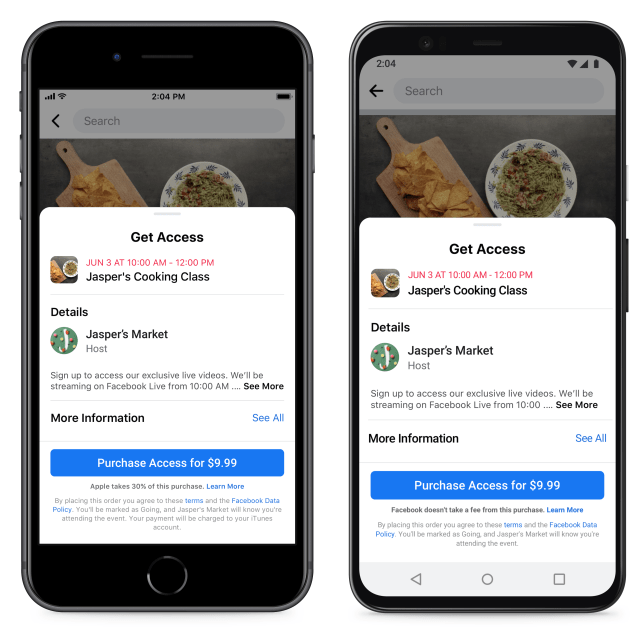
Facebook has become the latest company to rally against Apple’s fees for in-app purchases. The social network announced a new update, aimed at small businesses, which will allow companies to charge for online events. With the update, which wasfirst previewedin April, business owners could plan an online event, like a cooking or workout class, and charge their followers for access. But Facebook says business owners won’t be able to benefit from the feature as much as they should due to Apple’s developer policies. While Facebook says it doesn’t plan to take any cut from small business’ event revenue for “at least the next year,” it notes that Apple will still take its standard commission on purchases made via Facebook’s iOS app.
“We asked Apple to reduce its 30% App Store tax or allow us to offer Facebook Pay so we could absorb all costs for businesses struggling during COVID-19,” Facebook wrote in a blog post. “Unfortunately, they dismissed both our requests and SMBs will only be paid 70% of their hard-earned revenue.”
The social network said it plans to alert its users in its app that Apple gets a 30 percent cut of their purchase, and that it’s submitted the update for Apple’s approval and is awaiting a response. Apple didn’t immediately respond to a request for comment.
On Facebook’s Android app and website, events will use Facebook Pay so business owners will get the full amount, according to the company.
“What we are pushing on is that all tech companies who can afford to do so join us in supporting small businesses,” Facebook VP Fidji Simo said during a call with reporters Friday.
The move makes Facebook the latest tech giant to pile onto Apple as it faces antitrust scrutiny over its App Store policies. It comes one day after Fortite maker Epic sued the iPhone-maker after it kicked Fortnite out of the App Store over its attempt to bypass Apple’s 30 percent commission. Since then, Spotify and Tinder-owner Match Group have issued statements in support of EPic’s fight against Apple’s “unfair” policies.
But this is far from the first time a disagreement between Facebook and Apple has played out publicly. Apple has repeatedly criticized Facebook over its privacy policies and Apple briefly bricked Facebook’s internal apps after the company was caught violating its rules for enterprise apps.
Simo said the new event feature is meant to help businesses that have been hurt most by closures due to COVID-19. The feature will use Facebook Live, and is also being tested with Messenger Rooms. It will be available in 20 countries, including the United States, UK and Australia, to pages that meet its monetization rules.
Microsoft has been the only company so far to say publicly it’s pursuing TikTok
Twitter has had preliminary discussions about a “combination” with TikTok, the Wall Street Journal reported, making the social media platform the latest possible suitor for the popular video-sharing app. As the WSJ notes, it’s not clear whether Twitter would pursue a possible acquisition of TikTok, and any such deal would have big obstacles.
The biggest challenge to any deal is the Trump administration’s executive order from August 6th, which bars TikTok parent company ByteDance from handling transactions in the US. The order takes effect within 45 days. The administration considers the Chinese-owned app a potential security threat, despite no evidence indicating ByteDance or TikTok has ever shared Americans’ data with the Chinese government. TikTok has said it plans to challenge the Trump administration’s order.
And then there’s Microsoft, the only company so far to publicly acknowledge it was in talks with TikTok owner ByteDance for a possible acquisition. The WSJ says Twitter would be considered a long-shot in a bid for TikTok, with Microsoft the likely front runner in any deal. Twitter is much smaller than Microsoft, and the WSJ’s sources say the social platform could be likely to face less antitrust scrutiny than Microsoft. But Twitter also doesn’t have as much money as the software giant for a possible purchase.
Microsoft said in an August 2nd blog post that its CEO Satya Nadella had spoken to President Trump about a possible TikTok acquisition, which would include TikTok operations in the US, Australia, Canada, and New Zealand. Microsoft said it expected its talks to wrap by September 15th.
Any deal with Twitter would involve TikTok’s US operations, according to the WSJ.
Twitter declined to comment. A TikTok spokesperson said the company does not comment on market rumors.
Facebook has repeatedly overruled its own fact checkers in order to help conservative pages avoid punishment for spreading misinformation. That’s according to leaked documentsreported byNBC News, which found evidence that employees regularly intervene in the company’s fact-checking process to avoid the “PR risk” associated with punishing high-profile conservatives.
When Facebook’s third-party fact checkers mark something as false, the post is given less distribution in News Feed to make it harder for people to see it. Pages that repeatedly share posts that are debunked by fact checkers get “strikes.” Facebook punishes pages that get too many strikes by down-ranking their content, and blocking their ability to run ads.
People who run popular pages with large followings are able to appeal fact-checking decisions. And when conservatives who have criticized the social network for being biased against them appeal these decisions, Facebook has reportedly flagged the issue as requiring “escalation.” It’s then that Facebook’s team, “with direct oversight from company leadership,” steps in.
“The list and descriptions of the escalations, leaked to NBC News, showed that Facebook employees in the misinformation escalations team, with direct oversight from company leadership, deleted strikes during the review process that were issued to some conservative partners for posting misinformation over the last six months,” NBC writes. “The discussions of the reviews showed that Facebook employees were worried that complaints about Facebook's fact-checking could go public and fuel allegations that the social network was biased against conservatives.”
Pages for Breitbart, Donald Trump Jr., Eric Trump, the Gateway Pundit and Diamond and Silk have all gotten a pass under this process, according to NBC.
In a statement, a Facebook spokesperson said the company’s policy allows it to “determine that one or more of those ratings does not warrant additional consequences,” but didn’t elaborate on the process.
“We defer to third-party fact-checkers on the rating that a piece of content receives. When a fact checker applies a rating, we apply a label and demotion,” the spokesperson said. “But we are responsible for how we manage our internal systems for repeat offenders. We apply additional system wide penalties for multiple false ratings, including demonetization and the inability to advertise, unless we determine that one or more of those ratings does not warrant additional consequences. To this day, we remain the only company that partners with over 70 fact-checking organizations to apply fact-checks to millions of pieces of content.”
The report from NBC comes one day after BuzzFeed News also found that Facebook officials, including Brett Kavanaugh bff and global policy head Joel Kaplan, had intervened in order to help prominent conservatives get fact checks removed or otherwise avoid consequences for sharing misinformation. The social network later fired an employee who questioned these decisions on internal forums, according to BuzzFeed.





:format(webp)/cdn.vox-cdn.com/uploads/chorus_image/image/67176248/acastro_180130_1777_0008.0.jpg)

