It looks like BlackBerry hardware is back from the brink of extinction once again. Today, the security startup OnwardMobility announced plans to release a new 5G BlackBerry smartphone with a physical keyboard. It could arrive in North America and Europe as soon as the first half of 2021.
This may sound familiar. A few years ago, BlackBerry seemed to be a thing of the past. Then, TCL agreed to manufacture two BlackBerry-branded phones. In February, TCL decided not to renew the deal with BlackBerry, and this month, it stopped selling the devices. Thanks to OnwardMobility, BlackBerry may get one more chance.
OnwardMobility CEO Peter Franklin says the newest Blackberry will be both sleek and secure. The company plans to work closely with BlackBerry and FIH Mobile Limited, a subsidiary of Foxconn Technology Group.
“BlackBerry is thrilled OnwardMobility will deliver a BlackBerry 5G smartphone device with physical keyboard leveraging our high standards of trust and security synonymous with our brand,” BlackBerry CEO John Chen said in a statement.
It seems like licensing deals are the only way to get new BlackBerry devices. The last deal BlackBerry struck with a hardware maker was in 2016 to release phones in India. TCL was easily BlackBerry’s best shot, to date, at a comeback.
A little more than a year after its live streamed debut at the 2019 Geneva Auto Show, the Polestar 2 is finally ready to hit the streets. Engadget took the $60,000 premium electric vehicle for a drive this week to see how this EV fastback handles the challenging curves of the Santa Cruz hills.
The five-door Polestar 2 is outfitted with a 78kWh reinforced battery pack that delivers power to a pair of motors -- one each over the front and rear axles -- to produce 408 hp and 487 ft-pounds of torque with a range of 291 miles. However, if you opt for the $5,000 Performance pack that upgrades the suspension and brakes, along with 20-inch aluminum rims (instead of 19s) and gold-colored seat belts, the mileage will decrease noticeably. During my test drive in the Performance model, I started with a reported range of 210 miles at 100 percent battery charge. Even without the added performance though, the Polestar 2 can hit 60 mph from a standstill in 4.45 seconds, do a quarter-mile in 12.76, and tops out at just over 125 (electronically limited) mph.
Cargo capacity is at a premium inside the vehicle, with just 15.5 cubic feet of storage space unless you fold the rear seats down. That said, if you’re looking to haul groceries rather than a whole lot of ass, this might not be the EV for you. You might instead consider the Hyundai Kona Electric or Kia Niro EV, because this EV is certainly not an electric SUV.
The Polestar 2 was a blast to drive through the twists and turns of CA-35. Thanks to the electric motors’ instant access to torque, a mere flick of the gas pedal at the apex of a curve had me blasting out of it faster than when I entered. That quick acceleration was apparent in normal city driving both in the relative bustle of midmorning downtown San Francisco and the sleepy, sweltering sprawl of suburban Los Gatos. The one-pedal driving system proved to be pretty useful in light city traffic, enabling me to automatically slow to a crawl simply by lifting my foot off the gas. That feature can be turned off if you prefer a two-pedal driving experience. I had no trouble keeping up with traffic either on city streets, multilane boulevards or at freeway speeds. Especially at freeway speeds. It easily kept pace with the flow of traffic — even when that flow might have exceeded the posted speed limit.
Polestar / Beadyeye
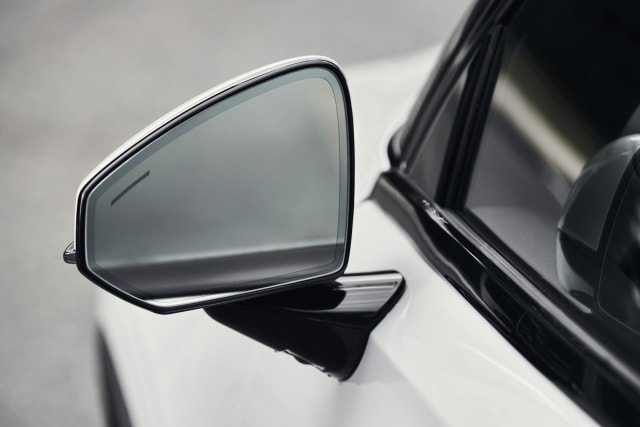
Your biggest concern will be making sure that the lane next to you is clear when you do try to pass because the Polestar 2’s blindspots are big enough to hide a MAC truck in. The A-pillars are broad, as are B-pillars. Plus, the side mirrors have been minimized to lower the drag coefficient, but they only give you a tiny peek at what’s in the lane next to you. I’d gladly take the reduced range if it meant I could get a better look at the traffic around me from larger mirrors.
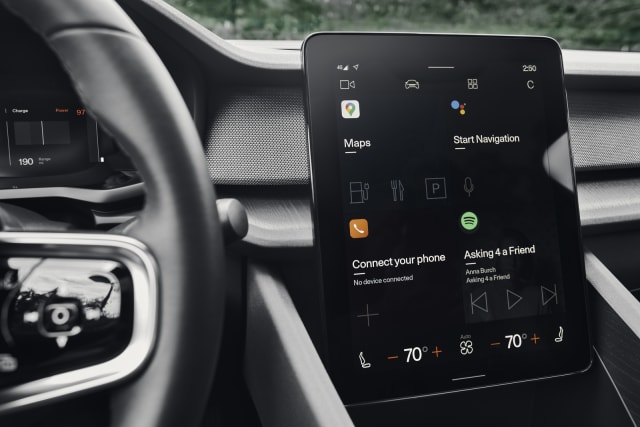
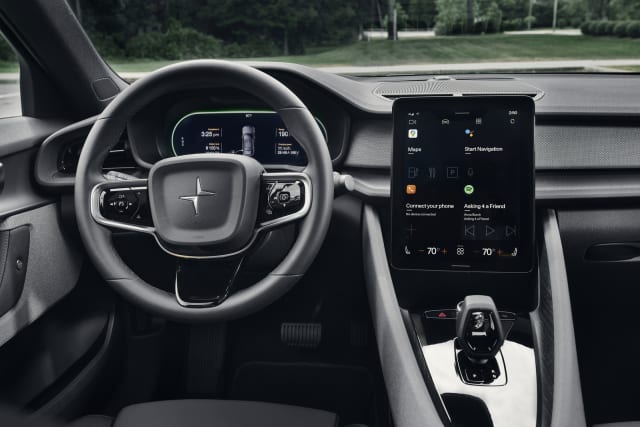
The centerpiece of the Polestar 2 is the vehicle’s fancy center console. It replaces virtually every knob, dial and switch with an 11-inch screen running one of the first versions of Android Automotive OS available to third-parties. Aside from the window and mirror controls, door locks and gear shift, everything is run through what looks like an iPad Pro set in portrait mode and crammed against the front of the dash. I’ve never been much of a fan of these sorts of controls. The idea of hunting through multiple sub-menus on a glorified tablet while navigating rush hour traffic has always given me the heebie-jeebies, but the AAOS system is remarkably straightforward and intuitive. I never tapped more than a couple times to get to the control I was looking for.
Polestar / Beadyeye
That’s not to say there isn’t a learning curve. I spent 10 sweltering minutes in 98 degrees weather trying to turn on the A/C for the first time but after that, the process took seconds. And to be fair, I could have just not been stubborn and said, “Hey Google, turn on the air conditioning and set the temperature to 68 degrees.” Because that works too and it’s pretty cool.
Typically when you pair your smartphone to your car’s infotainment system, it simply mirrors the phone’s functionality. AAOS, on the other hand, is a standalone system meaning you won’t have to physically plug your phone into it -- though you will need a Bluetooth connection to make calls and send texts.
Instead, you simply link the infotainment to your Google account. Doing so enables a deeper degree of integration, enabling drivers to use their preferred options when dealing with Maps for navigation, Google Play for media or Assistant for voice assist. What’s more, according to the Polestar press kit, if you’ve already own a Google Home, congrats, your Google account already has a bunch of recordings of your speech patterns so the infotainment system will more clearly understand you from the get-go.
“From a security perspective, similar things that we have on the phone are things that also exist in the vehicle,” Haris Ramic, Google product lead for Android Automotive, told Engadget. “So for example, you can go set it up, if you lock your account, it gets encrypted. And [to access that encrypted data] you have to either enter a PIN into the vehicle or sometimes to do something on the phone [such as 2-factor authentication] to open it up. When the vehicle does shut down, the user partitions, which is the area where all the user information is stored, also get encrypted.”
What’s more, Google is being cautious as to which companies are being allowed access to its fledgling OS’ APIs. “The goal is, obviously, not to focus just on big companies because innovation can come from anywhere. We don't want to provide a set of API's that anybody can use,” Ramic continued. “But partially the reason why we're going so slow is, rather than just opening up everything and saying anybody can develop anything they want, we're targeting areas where we know there's a lot of consumer value.”
Logging in to the infotainment system is not a requirement, mind you, it will work just fine without your credentials, just not with the same degree of personalization (and data privacy exposure) as if you did. During my test drive, I used a generic account provided by Polestar and paired my phone via Bluetooth. So while it wouldn’t play songs from my Google Music account, I still had easy access Maps, Assistant and Spotify.
Polestar / Beadyeye
Assistant was surprisingly effective and intelligent during the four-plus hours I had to play with it. I didn’t have to manually input any destinations, simply told Assistant where I wanted to go and the system automatically generated a route. This was way, way easier than the navigation experience we saw with the Cooper SE back in January. Assistant was generally unfazed by background noise, quickly responding over the sounds coming from the Polestar’s 16 speaker Harmon Kardon stereo system and really only got bogged down when trying to understand me while I shouted commands with the windows down at freeway speeds.
It did return a few incorrect results when I asked it to play specific bands. For example, when asked it to play The Coup, Spotify loaded up “In the Coupe” by Curren$y and Harry Fraud instead, or when I requested Chika, I got Chica. And yet somehow when I asked for Fear and Loathing in Las Vegas, the system correctly loaded “Return to Zero“ without hesitation. Whether that’s a shortcoming of Assistant’s ability to parse language or Spotify simply not having those artists in its catalog is something I couldn’t discern during the few hours I had the car. But it definitely made me long to have access to my existing Google Music playlists.
One issue I did run into was the fact that streaming media requires a 4G/LTE connection and when picking my way through the Santa Cruz hills, I often ran into service dead zones which would cut the music until the signal was restored (thankfully, it didn’t impact navigation.) This goes for streaming services like Google Music or Spotify as well as FM and AM radio stations (which are also streamed via an onboard app because AM radio signals play havoc with EVs.) Luckily you can easily get around this issue by making a hard connection between your phone and the system via one of four USB-C ports and playing media directly from the phone’s hard drive if you don’t want to chance it. The console also offers a 15w charging pad for induction-capable phones.
Volvo’s influence (as part-owner of the brand) is apparent in the vehicle’s broad array of safety and driver assist features. It will feature Level 2 ADAS, namely Pilot Assist (which is already being deployed in Volvo models like the V60 and the XC90) -- it provides acceleration, braking and steering up to 81 mph; blindspot, rear crash, and cross-traffic alerts; a lane-keeping aid, crash mitigation and avoidance. It even keeps an eye on the driver to make sure they’re staying focused on the road. That’s not to say it has cameras monitoring the driver or anything, the attention monitor is based on steering wheel contact. One unique safety feature of the Polestar 2 is its front inner-side airbags. These are mounted on either side of the center console and are designed to protect both driver and passenger from either shattering their femurs against the console or slamming into one another in the event that the vehicle gets hit from the side.
The car’s body is constructed from stamped steel with five paint options and a pair of interiors made from vegan materials, but if you want the Napa leather, it’s available for four grand extra. Why you’d spend that, I have no idea. The standard Weavetech seats are made from cork and recycled plastics (sans the phthalates which typically are used to increase material flexibility) and are very comfortable. The seat upholstery looks like leather but breathes like cotton -- even in triple-digit temperatures my backside remained dry.
Polestar is already working on three OTA updates for the coming months: a digital key similar to what we saw from Apple and BMW in July. That’s arriving later this year, as is a “connected safety” feature. Apple CarPlay compatibility should be ready by early 2021. If you’ve already got a preorder registered with Polestar, the first batch of vehicle deliveries should start arriving in September. Unfortunately, if you put down a deposit today, you’re looking at a December delivery date. Unusually spec’d orders (that is, color, interior and package combinations that not many people are asking for) are looking at a potentially similar time lag.
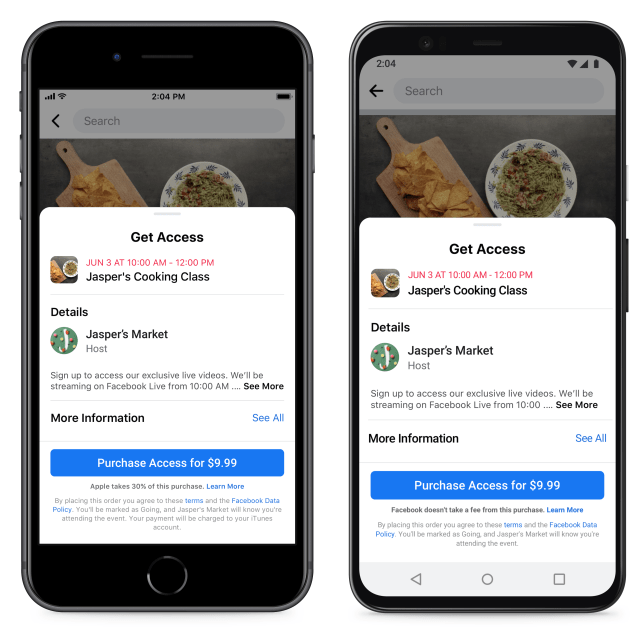
Facebook has become the latest company to rally against Apple’s fees for in-app purchases. The social network announced a new update, aimed at small businesses, which will allow companies to charge for online events. With the update, which wasfirst previewedin April, business owners could plan an online event, like a cooking or workout class, and charge their followers for access. But Facebook says business owners won’t be able to benefit from the feature as much as they should due to Apple’s developer policies. While Facebook says it doesn’t plan to take any cut from small business’ event revenue for “at least the next year,” it notes that Apple will still take its standard commission on purchases made via Facebook’s iOS app.
“We asked Apple to reduce its 30% App Store tax or allow us to offer Facebook Pay so we could absorb all costs for businesses struggling during COVID-19,” Facebook wrote in a blog post. “Unfortunately, they dismissed both our requests and SMBs will only be paid 70% of their hard-earned revenue.”
The social network said it plans to alert its users in its app that Apple gets a 30 percent cut of their purchase, and that it’s submitted the update for Apple’s approval and is awaiting a response. Apple didn’t immediately respond to a request for comment.
On Facebook’s Android app and website, events will use Facebook Pay so business owners will get the full amount, according to the company.
“What we are pushing on is that all tech companies who can afford to do so join us in supporting small businesses,” Facebook VP Fidji Simo said during a call with reporters Friday.
The move makes Facebook the latest tech giant to pile onto Apple as it faces antitrust scrutiny over its App Store policies. It comes one day after Fortite maker Epic sued the iPhone-maker after it kicked Fortnite out of the App Store over its attempt to bypass Apple’s 30 percent commission. Since then, Spotify and Tinder-owner Match Group have issued statements in support of EPic’s fight against Apple’s “unfair” policies.
But this is far from the first time a disagreement between Facebook and Apple has played out publicly. Apple has repeatedly criticized Facebook over its privacy policies and Apple briefly bricked Facebook’s internal apps after the company was caught violating its rules for enterprise apps.
Simo said the new event feature is meant to help businesses that have been hurt most by closures due to COVID-19. The feature will use Facebook Live, and is also being tested with Messenger Rooms. It will be available in 20 countries, including the United States, UK and Australia, to pages that meet its monetization rules.
It continues to be a good time to pick up an Apple laptop if you need one for work or school. Yesterday broughtdeals on the 13-inch MacBook Proand now you can save hundreds on the 16-inch MacBook Pro, too. Amazon has the laptopstarting at $2,099, which is $300 off its normal price. While the laptop dropped to $1,999 last month, this is still a great deal on the most powerful Apple laptop you can get.
The base model has that $2,099 sale price and it comes with a 9th-gen 2.6GHz Intel Core i7 processor, 16GB of RAM and a 512GB SSD. The upgraded model, with a 9th-gen 2.3GHz Intel Core i9 processor, 16GB of RAM and a 1TB SS, is $350 off coming in at $2,449.
Engadget’s Devindra Hardawar called the 16-inch MacBook Pro the “ultimate Apple laptop” and gave it a score of 90. It has a stellar CPU/GPU combo that’s built for power users and can handle almost any laborious task you throw at it without breaking a sweat. While you will hear its fans spinning, the laptop didn’t feel hot the the touch even while running our benchmark tests.
In addition to the pro-level internals, you’ll get a stunning 16-inch Retina display, a great speaker and mic combo and Apple’s updated Magic Keyboard. The company did away with the cumbersome (and often annoying) butterfly keys found on older MacBooks and brought back a more traditional scissor key mechanism. This makes typing on the 16-inch MacBook Pro much more comfortable and reliable.
But like most MacBooks, the 16-inch model suffers from a port deficit. It has just four Thunderbolt 3 ports, so you’ll still have to take dongles and adapters with you wherever you go. But at this point, that’s a sacrifice most people expect to make when they know they want to purchase a MacBook — and the tradeoff is often worth it. This sale on the 16-inch MacBook Pro is one to take advantage of if you need the most capable Apple laptop available. Those who prefer a smaller notebook that still packs a punch when it comes to power can consider the latest 13-inch MacBook Pros, which remain on sale at B&H Photo.
We had an inkling that theSurface Duo would be coming soon, and —after letting things slip a little early— Microsoft just confirmed it. The dual-screen Android phone is officially arriving on September 10th, with astarting price of $1,399. Pre-orders begin today. It’s rare to see a long-awaited device released earlier than expected, but it makes sense why Microsoft might be rushing things: It’s aiming to launch right in the middle of peak iPhone season. Last year’siPhone 11 launch eventwas also on September 10th, which is also close to previous debuts.
To recap, the Surface Duo features two screens connected by a 360-degree hinge. It's meant to be an adaptable device: You can fold it up to use it like a normal smartphone, hold it open like a booklet (similar to Microsoft's long-lost Courier project), or splay the two screens open like a tablet. And yes, you can even use one screen as a stand to prop it up on a table. Microsoft is taking the same approach with the slightly larger Surface Neo, a portable PC that'll run Windows apps (and is reportedly delayed until next year). But the Duo is the potentially more interesting device, since it marks Microsoft's return to smartphone hardware after Windows Phone fizzled so spectacularly.
The Surface Duo features Qualcomm’s Snapdragon 855 processor, 6GB of RAM and starts with 128GB of storage (you can get a 256GB model for $1,500). Its two 5.6-inch AMOLED screens sport a resolution of 1,800 x 1,350 each -- together they form a 8.1-inch display (with a hinge in the middle, of course). Microsoft says it’s the thinnest Surface device yet, measuring 4.8 millimeters when it's opened. At 0.55 pounds (250 grams), it's a touch heavier than the iPhone 11 Pro Max. But really, what else did you expect from a device that's wrapped in Gorilla Glass around two screens?
As Panos Panay, Microsoft's Chief Product Officer, demonstrated the Surface Duo in a media briefing, it was difficult to tell if the hardware changed much since it's debut last October. The software, on the other hand, seems far more polished for multi-tasking than any dual-screen or folding phone we've seen yet. If you're following a link from a text message or email, it'll pop open in a web browser on the other screen, so you won't be distracted. You can pair apps to open up together from together Android launcher (Panay says Microsoft CEO Satya Nadella is regularly using the Kindle app alongside a note-taking program).
You can also drag over content easily between the screens -- in the demo, Panay pulled over recipe ingredients from a website that instantly transformed into a bullet list in Microsoft's To Do app. That's something that would involve copying text, swapping apps, and pasting on a normal smartphone. Microsoft is clearly banking on the need for better multi-tasking in phones. Who wouldn't want an extra screen to browse the web without leaving a video call? Wouldn't email be easier to deal with if you could view all of your messages in one window, while reading them in another?
Still, as intrigued as I am, I can already see a few potential issues with the Surface Duo. For one, typing might be a bit annoying in certain orientations. If you click a text field on the left screen in booklet mode, you'll get a one-handed keyboard that's aligned to your left thumb. That seems like a good idea, but I can't imagine typing much with a single finger, and it seems too awkward to lean over with your right hand. Instead, you'll have to flip the Duo around into landscape mode to get a large keyboard suitable for both thumbs. You can also use any Surface Pen to jot down notes, but that's something you'll have to buy separately and carry around in your pocket, since there's no way to attach it to the Duo.
Microsoft is also going directly against the multi-camera smartphone trend. The Surface Duo just has a single 11-megapixel shooter located above its right screen. It looks a typical front-facing lens -- to use it as a rear camera, you just have to fold the screen back. While Microsoft says the Duo has a portrait mode and can shoot multi-frame HDR photos, that's all software based. It won't be able to take advantage of different lens lengths like other premium smartphones. There's no mention of any night shooting mode either, so you can likely forget about decent low-light performance. While Microsoft could still end up surprising us with the camera, the specs don't give me much hope.
The Surface Duo might also seem a bit quaint now that Samsung has unveiled the Galaxy Z Fold 2, its third attempt at making flexible phones work. But Panay, ever the company man, thinks there's a very clear reason why Microsoft opted to build devices with two separate, hinge-connected displays. "I do believe in windows," he said. "I believe in windowing." The company has found that users multi-task differently when they can organize their work across two separate displays, instead of a single screen. And of course, it also helps that the Duo is much cheaper than the original Galaxy Z Fold, which cost well over $2,000 (we still don't know the pricing of the Z Fold 2). The $1,380 Galaxy Z Flip is a bit more reasonable, but it's smaller screen isn't nearly as useful as the Surface Duo's.
You can pre-order the Surface Duo at the Microsoft Store, AT&T and Best Buy. It'll also work on T-Mobile and Verizon's networks, if you nab an unlocked model.
It supports 50W wireless charging and 120W wired charging.
Early this year, Xiaomi revealed two flagship phones, the Mi 10 and Mi 10 Pro. Today, to celebrate the company’s 10th anniversary, Xiaomi is adding to the Mi 10 lineup. It announced the Mi 10 Ultra, which comes with impressive camera specs, 50W wireless charging and 120W wired charging.
While theMi 10 Proboasts a 108 megapixel camera with 50x hybrid zoom and 8K capture mode, the Mi 10 Ultra promises a 48 megapixel periscopic telephoto camera with 10x optical zoom, 120x hybrid zoom and 8K video capture -- that’s similar to the zoom on theGalaxy S20 Ultra. The Mi 10 Ultra also has a 48 megapixel main camera, 20 megapixel ultra-wide camera (128-degree field of view) and 12 megapixel portrait camera.
The Mi 10 Ultra has a 6.67-inch FHD+ OLED display with 800-nit brightness, 10-bit color depth and curved edges. Each screen panel is individually calibrated for color accuracy, and the display has a 120Hz refresh rate. The Ultra comes with a 4,500mAh dual-cell battery (smaller than the Mi 10’s 4,780 mAh battery). Like the Mi 10 and Mi 10 Pro, the Mi 10 Ultra offers wireless charging, but unlike those models, which support 30W wireless charging, the Mi 10 Ultra offers 50W wireless charging (120W wired charging).
Pricing starts at 5,299 yuan (about $760) for 8GB of RAM and 128GB of storage. The most expensive combo, 16GB RAM and 512GB of storage, costs 6,999 yuan (about $1,010). You’ll be able to choose from three colors -- ceramic black, silver and transparent -- which pay homage to three of Xiaomi’s classic designs, a fitting tribute for a 10th anniversary device. We don’t know when the phone will arrive in the US or Europe yet, but we’ll update you when we do.




/cdn.vox-cdn.com/uploads/chorus_asset/file/19393643/vpavic_191118_3800_0058.jpg)


