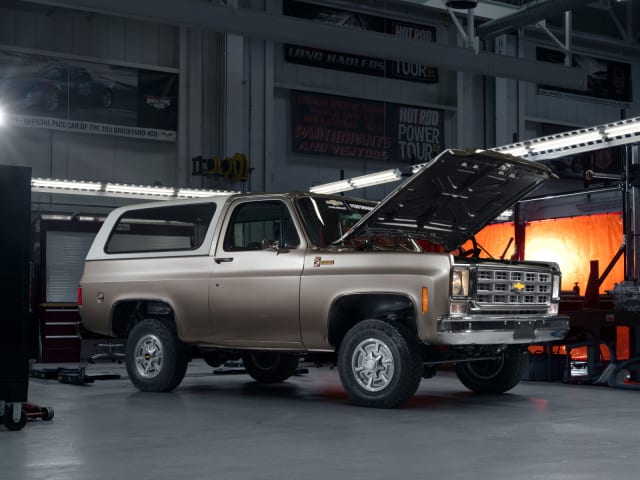
You’ll soon be able to buy an electric Chevrolet motor just as easily as one of its gas engines. After years of prototypes, the automaker plans to start selling crate electric motors and batteries to consumers by the second half of next year (via autoblog). And to showcase what you’ll be able to do with the tech, Chevy detailed a 1977 K5 Blazer conversion its Performance team completed using a near-production eCreate motor kit
Chevrolet
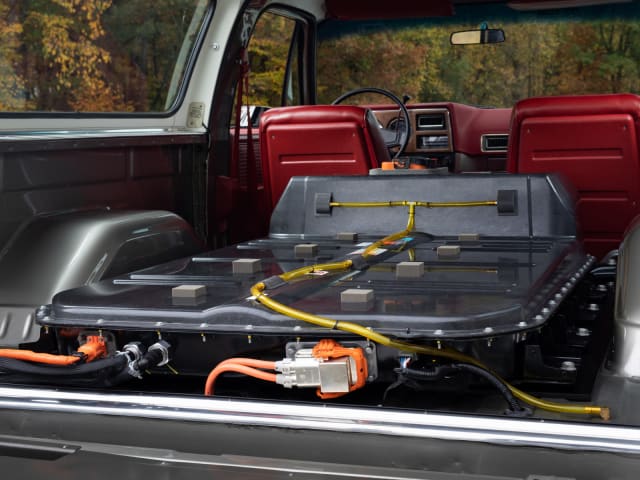
Chevy says approximately 90 percent of the new components it installed in the Blazer are Bolt EV parts straight from the factory, including the 200 horsepower motor that makes up the heart of the retrofit. Likewise borrowed from the Bolt is a 60kWh battery, which Chevy installed in the car’s cargo area. By using production controllers and wiring harnesses, it was able to carry over features like regenerative braking to the Blazer. What it didn’t need to replace was the majority of the drivetrain, with the transfer case, driveshaft and axles left untouched.
In most cases it sounds like you’ll need to buy some additional parts to turn an old gas guzzler into an EV. In the case of the K5, Chevy installed an aftermarket electric steering kit, an electric pump and an electronic controller to allow the Blazer’s analog fuel gauge to display remaining battery power.
Chevrolet
While the automaker didn’t announce pricing for the package, it did say it plans to certify dealers and aftermarket shops on their installation. It’s also exploring offering high-performance eCrate motors and batteries in different configurations.
Tesla’s Full Self-Driving beta is already making some significant (and arguably needed) strides forward. Electreksays the automaker has rolled out an update that, according to Elon Musk, should reduce the need for human intervention by about a third. He didn’t elaborate on what led to the improvements besides more real-world use, but that’s still a huge leap for an initial update.
You can expect more Full Self-Driving updates every five to ten days, Musk added. He further acknowledged that the system would never be perfect, but hoped the likelihood of an error would eventually dip “far lower” than what you’d expect from a human.
These kinds of rapid improvements may well be necessary. Tesla still hopes to make the FSD beta widely accessible by the end of 2020, and that might only happen when the system is reliable enough that most drivers will feel comfortable using it.
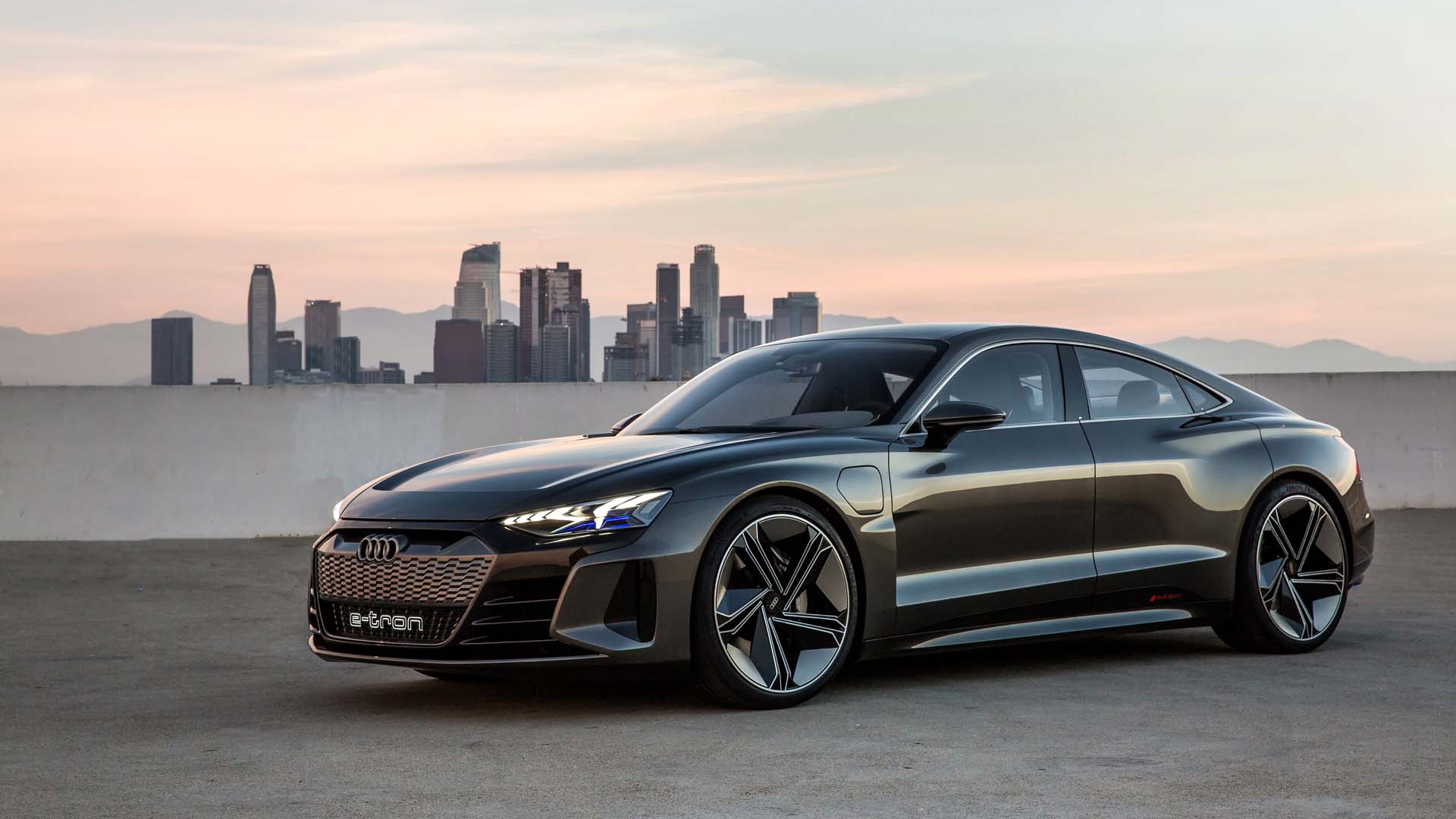
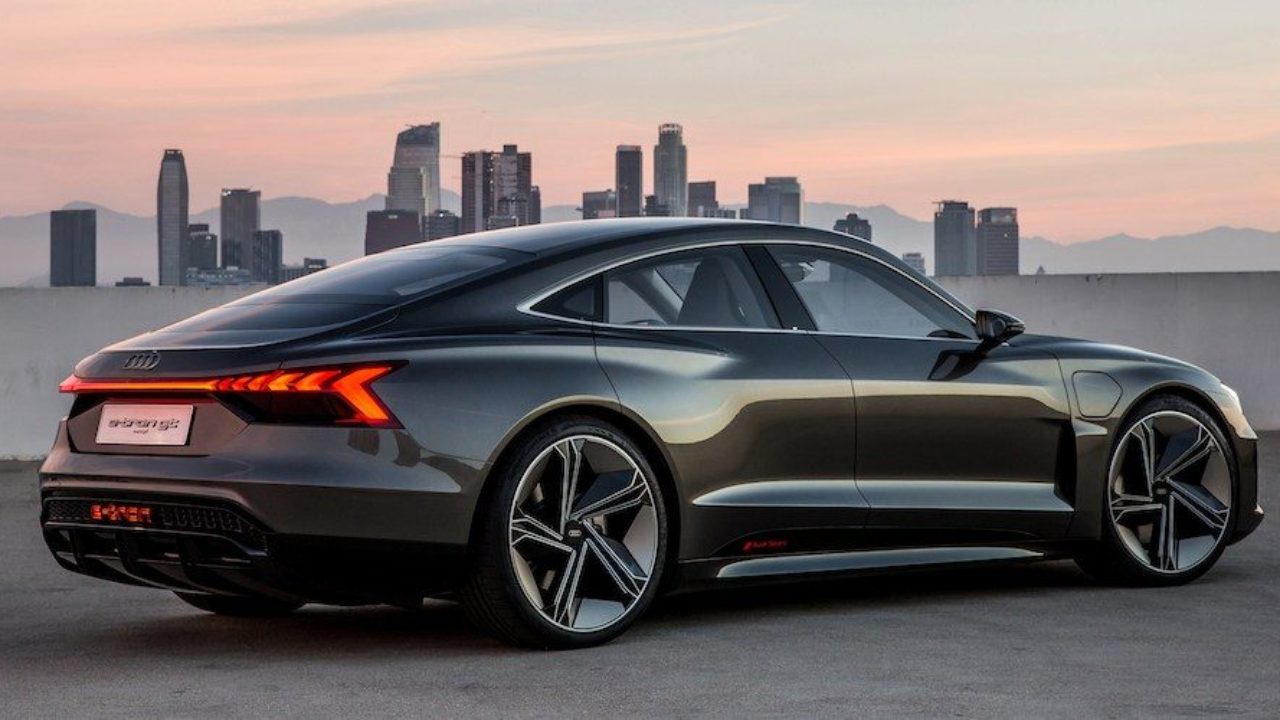
Car makers are making afuss over the artificial soundsthey’rerequired to producefor their EVs, and Audi is no exception. The German brandexplainedtoAutoblogjust how it created the sound for the productionE-Tron GT, noting that it was an elaborate process. Audi created the sound from 32 distinct elements using custom software and some ad-hoc discovery. The “foundation” was a 9.8-foot plastic pipe with a fan grafted to one end, producing a low growl that suited the E-Tron GT’s sporty nature.
The company’s Stephan Gsell noted the challenge of finding a sound that was pleasing, but also something you could live with every day. A Star Wars podracer sound might be a blast in short bursts, for example, but the novelty could wear off quickly during your daily commute.
Audi didn’t borrow from the Porsche Taycan while working on the sound, the company said, although it did use similar techniques and was working on it at roughly the same time.
The result is a sound that’s not quite as sci-fi as what you’ll find in the Taycan, but also not just a simple attempt to recreate a gas engine. We’re not quite sure it’s the “emotional” experience Audi claims it is, but that’s not entirely the point. The sound is at once a legal requirement to alert pedestrians as well as a void-filler for people who might be unsettled by the near silence of an EV cabin. And importantly, it’s optional on the inside — you can choose the intensity or turn it off altogether.
If you’re wealthy enough to be in the market for an E-Tron GT, you won’t have to wait too long to try it. Production is due to start near the end of 2020, albeit in small numbers.
A little more than a year after its live streamed debut at the 2019 Geneva Auto Show, the Polestar 2 is finally ready to hit the streets. Engadget took the $60,000 premium electric vehicle for a drive this week to see how this EV fastback handles the challenging curves of the Santa Cruz hills.
The five-door Polestar 2 is outfitted with a 78kWh reinforced battery pack that delivers power to a pair of motors -- one each over the front and rear axles -- to produce 408 hp and 487 ft-pounds of torque with a range of 291 miles. However, if you opt for the $5,000 Performance pack that upgrades the suspension and brakes, along with 20-inch aluminum rims (instead of 19s) and gold-colored seat belts, the mileage will decrease noticeably. During my test drive in the Performance model, I started with a reported range of 210 miles at 100 percent battery charge. Even without the added performance though, the Polestar 2 can hit 60 mph from a standstill in 4.45 seconds, do a quarter-mile in 12.76, and tops out at just over 125 (electronically limited) mph.
Cargo capacity is at a premium inside the vehicle, with just 15.5 cubic feet of storage space unless you fold the rear seats down. That said, if you’re looking to haul groceries rather than a whole lot of ass, this might not be the EV for you. You might instead consider the Hyundai Kona Electric or Kia Niro EV, because this EV is certainly not an electric SUV.
The Polestar 2 was a blast to drive through the twists and turns of CA-35. Thanks to the electric motors’ instant access to torque, a mere flick of the gas pedal at the apex of a curve had me blasting out of it faster than when I entered. That quick acceleration was apparent in normal city driving both in the relative bustle of midmorning downtown San Francisco and the sleepy, sweltering sprawl of suburban Los Gatos. The one-pedal driving system proved to be pretty useful in light city traffic, enabling me to automatically slow to a crawl simply by lifting my foot off the gas. That feature can be turned off if you prefer a two-pedal driving experience. I had no trouble keeping up with traffic either on city streets, multilane boulevards or at freeway speeds. Especially at freeway speeds. It easily kept pace with the flow of traffic — even when that flow might have exceeded the posted speed limit.
Polestar / Beadyeye
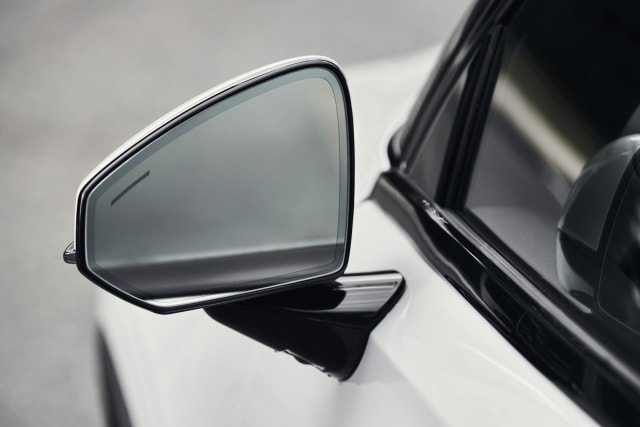
Your biggest concern will be making sure that the lane next to you is clear when you do try to pass because the Polestar 2’s blindspots are big enough to hide a MAC truck in. The A-pillars are broad, as are B-pillars. Plus, the side mirrors have been minimized to lower the drag coefficient, but they only give you a tiny peek at what’s in the lane next to you. I’d gladly take the reduced range if it meant I could get a better look at the traffic around me from larger mirrors.
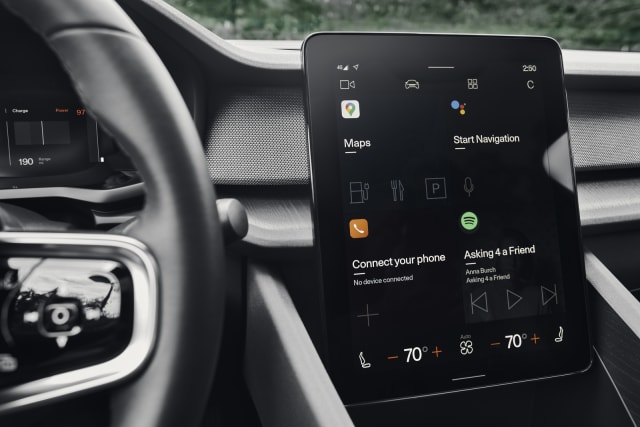
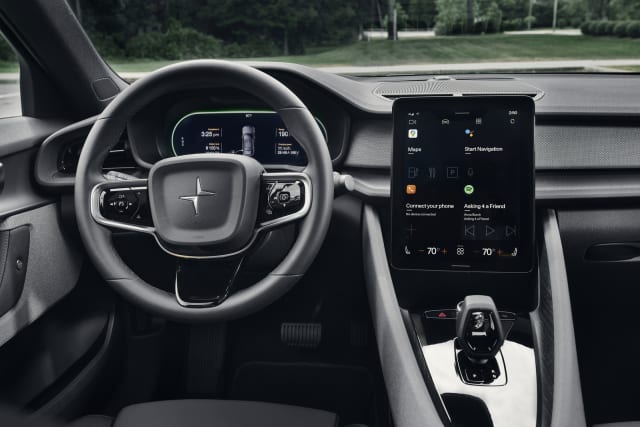
The centerpiece of the Polestar 2 is the vehicle’s fancy center console. It replaces virtually every knob, dial and switch with an 11-inch screen running one of the first versions of Android Automotive OS available to third-parties. Aside from the window and mirror controls, door locks and gear shift, everything is run through what looks like an iPad Pro set in portrait mode and crammed against the front of the dash. I’ve never been much of a fan of these sorts of controls. The idea of hunting through multiple sub-menus on a glorified tablet while navigating rush hour traffic has always given me the heebie-jeebies, but the AAOS system is remarkably straightforward and intuitive. I never tapped more than a couple times to get to the control I was looking for.
Polestar / Beadyeye
That’s not to say there isn’t a learning curve. I spent 10 sweltering minutes in 98 degrees weather trying to turn on the A/C for the first time but after that, the process took seconds. And to be fair, I could have just not been stubborn and said, “Hey Google, turn on the air conditioning and set the temperature to 68 degrees.” Because that works too and it’s pretty cool.
Typically when you pair your smartphone to your car’s infotainment system, it simply mirrors the phone’s functionality. AAOS, on the other hand, is a standalone system meaning you won’t have to physically plug your phone into it -- though you will need a Bluetooth connection to make calls and send texts.
Instead, you simply link the infotainment to your Google account. Doing so enables a deeper degree of integration, enabling drivers to use their preferred options when dealing with Maps for navigation, Google Play for media or Assistant for voice assist. What’s more, according to the Polestar press kit, if you’ve already own a Google Home, congrats, your Google account already has a bunch of recordings of your speech patterns so the infotainment system will more clearly understand you from the get-go.
“From a security perspective, similar things that we have on the phone are things that also exist in the vehicle,” Haris Ramic, Google product lead for Android Automotive, told Engadget. “So for example, you can go set it up, if you lock your account, it gets encrypted. And [to access that encrypted data] you have to either enter a PIN into the vehicle or sometimes to do something on the phone [such as 2-factor authentication] to open it up. When the vehicle does shut down, the user partitions, which is the area where all the user information is stored, also get encrypted.”
What’s more, Google is being cautious as to which companies are being allowed access to its fledgling OS’ APIs. “The goal is, obviously, not to focus just on big companies because innovation can come from anywhere. We don't want to provide a set of API's that anybody can use,” Ramic continued. “But partially the reason why we're going so slow is, rather than just opening up everything and saying anybody can develop anything they want, we're targeting areas where we know there's a lot of consumer value.”
Logging in to the infotainment system is not a requirement, mind you, it will work just fine without your credentials, just not with the same degree of personalization (and data privacy exposure) as if you did. During my test drive, I used a generic account provided by Polestar and paired my phone via Bluetooth. So while it wouldn’t play songs from my Google Music account, I still had easy access Maps, Assistant and Spotify.
Polestar / Beadyeye
Assistant was surprisingly effective and intelligent during the four-plus hours I had to play with it. I didn’t have to manually input any destinations, simply told Assistant where I wanted to go and the system automatically generated a route. This was way, way easier than the navigation experience we saw with the Cooper SE back in January. Assistant was generally unfazed by background noise, quickly responding over the sounds coming from the Polestar’s 16 speaker Harmon Kardon stereo system and really only got bogged down when trying to understand me while I shouted commands with the windows down at freeway speeds.
It did return a few incorrect results when I asked it to play specific bands. For example, when asked it to play The Coup, Spotify loaded up “In the Coupe” by Curren$y and Harry Fraud instead, or when I requested Chika, I got Chica. And yet somehow when I asked for Fear and Loathing in Las Vegas, the system correctly loaded “Return to Zero“ without hesitation. Whether that’s a shortcoming of Assistant’s ability to parse language or Spotify simply not having those artists in its catalog is something I couldn’t discern during the few hours I had the car. But it definitely made me long to have access to my existing Google Music playlists.
One issue I did run into was the fact that streaming media requires a 4G/LTE connection and when picking my way through the Santa Cruz hills, I often ran into service dead zones which would cut the music until the signal was restored (thankfully, it didn’t impact navigation.) This goes for streaming services like Google Music or Spotify as well as FM and AM radio stations (which are also streamed via an onboard app because AM radio signals play havoc with EVs.) Luckily you can easily get around this issue by making a hard connection between your phone and the system via one of four USB-C ports and playing media directly from the phone’s hard drive if you don’t want to chance it. The console also offers a 15w charging pad for induction-capable phones.
Volvo’s influence (as part-owner of the brand) is apparent in the vehicle’s broad array of safety and driver assist features. It will feature Level 2 ADAS, namely Pilot Assist (which is already being deployed in Volvo models like the V60 and the XC90) -- it provides acceleration, braking and steering up to 81 mph; blindspot, rear crash, and cross-traffic alerts; a lane-keeping aid, crash mitigation and avoidance. It even keeps an eye on the driver to make sure they’re staying focused on the road. That’s not to say it has cameras monitoring the driver or anything, the attention monitor is based on steering wheel contact. One unique safety feature of the Polestar 2 is its front inner-side airbags. These are mounted on either side of the center console and are designed to protect both driver and passenger from either shattering their femurs against the console or slamming into one another in the event that the vehicle gets hit from the side.
The car’s body is constructed from stamped steel with five paint options and a pair of interiors made from vegan materials, but if you want the Napa leather, it’s available for four grand extra. Why you’d spend that, I have no idea. The standard Weavetech seats are made from cork and recycled plastics (sans the phthalates which typically are used to increase material flexibility) and are very comfortable. The seat upholstery looks like leather but breathes like cotton -- even in triple-digit temperatures my backside remained dry.
Polestar is already working on three OTA updates for the coming months: a digital key similar to what we saw from Apple and BMW in July. That’s arriving later this year, as is a “connected safety” feature. Apple CarPlay compatibility should be ready by early 2021. If you’ve already got a preorder registered with Polestar, the first batch of vehicle deliveries should start arriving in September. Unfortunately, if you put down a deposit today, you’re looking at a December delivery date. Unusually spec’d orders (that is, color, interior and package combinations that not many people are asking for) are looking at a potentially similar time lag.
Audi wants to give prospective buyers of its electric Q4 SUVs plenty of options, so it has just unveiled the Q4 Sportback E-Tron concept — a “sexy back” coupé version of the Q4 E-Tron SUV it unveiled last year. The two vehicles will share Audi’s modular electrification platform (MEB), meaning the Sportback will pack an 82 kWh battery with 280 miles (WLPT) of range. It also shares the same 225kW electric powertrain that can propel it from 0-62 mph in 6.3 seconds.
The interior, lighting, modeled fenders, large 22-inch wheels and other features will be the same on both vehicles, too. However, where the original Q4 E-Tron gives off a rugged SUV vibe, the Q4 Sportback concept has a more refined, rounded look. The D-pillars at the rear also slope more, making the Sportback version look longer, Audi noted.
Inside, you’ll find a large-format heads-up display with a new augmented reality feature. That can display key info like GPS turning arrows “directly on the course of the road,” Audi said. It also offers a 12.3-inch touchscreen for infotainment and vehicle functions, with a strip of buttons below the A/C for control.
Both Q4 E-Tron vehicles are smaller and considerably cheaper than the original E-Tron and E-Tron Sportback EVs. They can go farther on a charge, to boot, as the original Sportback E-Tron is only rated for 270 miles (max) by WLPT standards. The quattro all-wheel drive Q4 Sportback versions will go 280 miles, while the rear-wheel drive versions will be rated for up to 311 miles, again by WLPT standards (EPA ratings will be considerably less).
Audi hasn’t released pricing for the Q4 Sportback E-Tron yet. However, the regular Q4 E-Tron model is expected to cost in the neighborhood of $45,000, so the Sportback version should be around that price too. That’s a full $30,000 less than the regular E-Tron, and puts the Q4 Sportback E-Tron into the Tesla Model 3 and Model Y price category. While it won’t match those vehicles in terms of range, Audi buyers can probably expect a higher level of build quality.
Tesla has appeared in a JD Power Initial Quality Study for the first time, and it doesn’t look good for the electric car maker — although the story is more complex than it sounds. JD Power ranked Tesla last out of 32 brands operating in the US, with 250 problems per 100 vehicles. The top brands, Dodge and Kia, had ‘just’ 136 problems. Tesla wasn’t officially participating in the study as it doesn’t grant permission to survey owners in 15 states where it’s required, but JD Power collected enough surveys (about 1,250) from other states to produce a score.
That’s not a sterling result, but the numbers don’t say everything. JD Power automotive president Doug Betts told CNBC that Tesla’s issues were mostly related to production-related issues like body panel gaps, paint flaws and squeaks. For contrast, nearly a quarter of all automakers’ problems stemmed from infotainment issues like touchscreens, phone connectivity and built-in navigation. Tesla vehicles may have more issues, then, but they’re less likely to be ones that affect the basic functionality of the car.
We’ve asked Tesla for comment.
These findings aren’t completely surprising. Tesla has been scrambling to boost production and make cars like the Model 3 profitable, and there have long been concerns that refinement wasn’t the highest priority. It’s not uncommon to read new owners’ stories of panel gaps and other small but irksome issues, particularly for earlier production runs of a given EV. It’s not certain how Tesla will respond to the study, but this could spur on critics who want the company to focus less on car delivery numbers and more on the quality of the cars that reach customers.

 Chevrolet
 Chevrolet