Earnings week seems to arrive just a little bit sooner every fall — or it could just be the nonstop cheering from Big Tech who had a banner quarter thanks to the COVID quarantine turning many of us into a captive audience for their products and services. Here are some headlines from the week that was.
What, you thought your child was just going to indoctrinate themselves to life within the surveillance state? For free? In this economy? Not a chance. Not when Jeff Bezos can ding you for a trio of Benjamins on the way out.
Speaking of Jeff Bezos getting even more wealthy, Amazon made an extra $26 billion in sales during Q3 2020 thanks to our shelter in place rules and everybody embracing delivery for, well, everything.
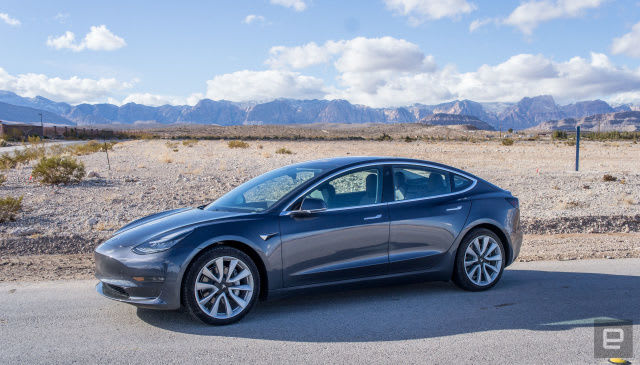
Oh the woes of Tesla ownership. First the company offered a $2,500 infotainment system upgrade that gave customers access to YouTube, Netflix, Hulu — none of which should be watched while operating a motor vehicle mind you, unless you spring for the $10,000 FSD mode (though it’s being called is a “distant second” to GMC’s SuperCruise) — but had to ditch the existing AM, FM and Sirius functions. Now the company is offering to restore the FM and Sirius capabilities that used to be there with the addition of a new tuner and antenna for the low, low discount price of $500.
Netflix is yet again getting a little more expensive. The company announced last week that its standard plan will now cost $14, a dollar increase, and its premium plan will rise two dollars to $18 a month. I’m old enough to remember when cord cutting actually saved people money.
Under Armour is looking to shed some weight, namely its MyFitnessPal and Endomondo apps. The former is being put up for sale with a $345 million price tag, the latter is simply being shut down, all so that the company can achieve a greater degree of “investment flexibility.”
Spotify might be adding real-time lyrics to its app, again. Dozens of Twitter users around the world have reported that lyrics are now popping up as they listen to Spotify. A user with beta 8.5.46.848 confirmed the feature to Android Police. But, this seems to be server-side enabled, as not all users with that beta can see the lyrics.
But this isn't Spotify's first karaoke. The lyrics showing up today are provided through Musixmatch, the same company Spotify partnered with to deliver lyrics in the past. In 2016, the companies ended their partnership.
"It was a great partnership and there is mutual respect between both companies as our business strategies move us each in different directions," a Spotify spokesperson told Engadget at the time. It's unclear what changed, but hopefully this time around the partnership will last.
Today, a Spotify spokesperson offered the company's standard canned response:
"At Spotify, we routinely conduct a number of tests in an effort to improve our user experience. Some of those tests end up paving the way for our broader user experience and others serve only as an important learning. We don't have any further news to share at this time."
Teraflops have been a popular way to measure "graphical power" for years. The term refers to the number of calculations a GPU can perform, but while it’s been on spec sheets forever, more recently the teraflop has gone mainstream, appearing in marketing messages found in the launch of consoles like the Xbox Series X. With GPU core counts reaching five figures, it’s nice to have a simple point of comparison. Unfortunately, teraflops have never been less useful.
The term teraflop comes from FLOPs, or "floating-point operations per second," which simply means “calculations that involve decimal points per seconds.” Tera means trillion, so put together teraflops means “trillion floating-point operations per second.”
The most popular GPU among Steam users today, NVIDIA's venerable GTX 1060, is capable of performing 4.4 teraflops, the soon-to-be-usurped 2080 Ti can handle around 13.5 and the upcoming Xbox Series X can manage 12. These numbers are calculated by taking the number of shader cores in a chip, multiplying that by the peak clock speed of the card and then multiplying that by the number of instructions per clock. In contrast to many figures we see in the PC space, it's a fair and transparent calculation, but that doesn’t make it a good measure of gaming performance.
Almost every GPU family arrives with these generational gains
AMD’s RX 580, a 6.17-teraflop GPU from 2017, for example, performs similarly to the RX 5500, a budget 5.2-teraflop card the company launched last year. This sort of "hidden" improvement can be attributed to many factors, from architectural changes to game developers making use of new features, but almost every GPU family arrives with these generational gains. That's why the Xbox Series X, for example, is expected to outperform the Xbox One X by more than the “12 versus 6 teraflop” figures suggest. (Ditto for the PS5 and the PS4 Pro.)
The point is that, even within the same GPU company, with each year, changes in the ways chips and games are designed make it harder to discern what exactly "a teraflop" means to gaming performance. Take an AMD card and an NVIDIA card of any generation and the comparison has even less value.
All of which brings us to the RTX 3000 series. These arrived with some truly shocking specs. The RTX 3070, a $500 card, is listed as having 5,888 cuda (NVIDIA’s name for shader) cores capable of 20 teraflops. And the new $1,500 flagship card, the RTX 3090? 10,496 cores, for 36 teraflops. For context, the RTX 2080 Ti, as of right now the best "consumer" graphics card available, has 4,352 "cuda cores.” NVIDIA, then, has increased the number of cores in its flagship by over 140 percent, and its teraflops capability by over 160 percent.
Well, it has, and it hasn’t.
NVIDIA cards are made up of many "streaming multiprocessors," or SMs. Each of the 2080 Ti's 68 "Turing" SMs contain, among many other things, 64 "FP32" cuda cores dedicated to floating-point math and 64 "INT32" cores dedicated to integer math (calculations with whole numbers).
The big innovation in the Turing SM, aside from the AI and ray-tracing acceleration, was the ability to execute integer and floating-point math simultaneously. This was a significant change from the prior generation, Pascal, where banks of cores would flip between integer and floating-point on an either-or basis.
NVIDIA
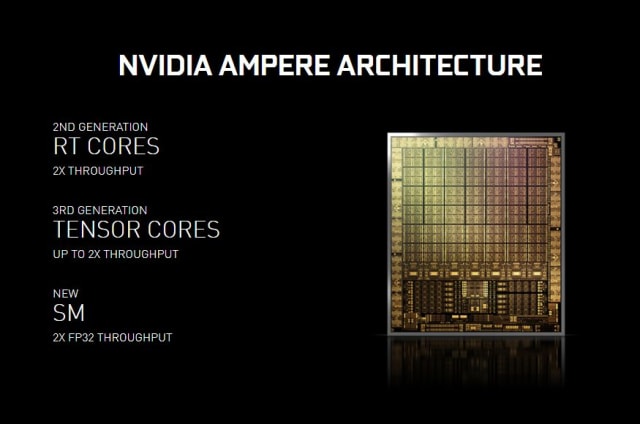
The RTX 3000 cards are built on an architecture NVIDIA calls "Ampere," and its SM, in some ways, takes both the Pascal and the Turing approach. Ampere keeps the 64 FP32 cores as before, but the 64 other cores are now designated as "FP32 and INT32.” So, half the Ampere cores are dedicated to floating-point, but the other half can perform either floating-point or integer math, just like in Pascal.
With this switch, NVIDIA is now counting each SM as containing 128 FP32 cores, rather than the 64 that Turing had. The 3070's "5,888 cuda cores" are perhaps better described as "2,944 cuda cores, and 2,944 cores that can be cuda."
As games have become more complex, developers have begun to lean more heavily on integers. An NVIDIA slide from the original 2018 RTX launch suggested that integer math, on average, made up about a quarter of in-game GPU operations.
The downside of the Turing SM is the potential for under-utilization. If, for example, a workload is 25-percent integer math, around a quarter of the GPU’s cores could be sitting around with nothing to do. That’s the thinking behind this new semi-unified core structure, and, on paper, it makes a lot of sense: You can still run integer and floating-point operations simultaneously, but when those integer cores are dormant, they can run floating-point instead.
[This episode of Upscaled was produced before NVIDIA explained the SM changes.]
At NVIDIA's RTX 3000 launch, CEO Jensen Huang said the RTX 3070 was "more powerful than the RTX 2080 Ti." Using what we now know about Ampere's design, integer, floating-point, clock speeds and teraflops, we can see how things might pan out. In that “25-percent integer” workload, 4,416 of those cores could be running FP32 math, with 1,472 handling the necessary INT32.
Coupled with all the other changes Ampere brings, the 3070 could outperform the 2080 Ti by perhaps 10 percent, assuming the game doesn't mind having 8GB instead of 11GB memory to work with. In the absolute (and highly unlikely) worst-case scenario, where a workload is extremely integer-dependent, it could behave more like the 2080. On the other hand, if a game requires very little integer math, the boost over the 2080 Ti could be enormous.
Guesswork aside, we do have one point of comparison so far: a Digital Foundry video comparing the RTX 3080 to the RTX 2080. DF saw a 70 to 90 percent lift across generations in several games that NVIDIA presented for testing, with the performance gap higher in titles that utilize RTX features like ray tracing. That range gives a glimpse of the sort of variable performance gain we’d expect given the new shared cores. It’ll be interesting to see how a larger suite of games behaves, as NVIDIA is likely to have put its best foot forward with the sanctioned game selection. What you won’t see is the nearly-3x improvement that the jump from the 2080’s teraflop figure to the 3080’s teraflop figure would imply.
With the first RTX 3000 cards arriving in weeks, you can expect reviews to give you a firm idea of Ampere performance soon. Though even now it feels safe to say that Ampere represents a monumental leap forward for PC gaming. The $499 3070 is likely to be trading blows with the current flagship, and the $699 3080 should offer more-than enough performance for those who might previously have opted for the “Ti.” However these cards line up, though, it’s clear that their worth can no longer be represented by a singular figure like teraflops.
A little more than a year after its live streamed debut at the 2019 Geneva Auto Show, the Polestar 2 is finally ready to hit the streets. Engadget took the $60,000 premium electric vehicle for a drive this week to see how this EV fastback handles the challenging curves of the Santa Cruz hills.
The five-door Polestar 2 is outfitted with a 78kWh reinforced battery pack that delivers power to a pair of motors -- one each over the front and rear axles -- to produce 408 hp and 487 ft-pounds of torque with a range of 291 miles. However, if you opt for the $5,000 Performance pack that upgrades the suspension and brakes, along with 20-inch aluminum rims (instead of 19s) and gold-colored seat belts, the mileage will decrease noticeably. During my test drive in the Performance model, I started with a reported range of 210 miles at 100 percent battery charge. Even without the added performance though, the Polestar 2 can hit 60 mph from a standstill in 4.45 seconds, do a quarter-mile in 12.76, and tops out at just over 125 (electronically limited) mph.
Cargo capacity is at a premium inside the vehicle, with just 15.5 cubic feet of storage space unless you fold the rear seats down. That said, if you’re looking to haul groceries rather than a whole lot of ass, this might not be the EV for you. You might instead consider the Hyundai Kona Electric or Kia Niro EV, because this EV is certainly not an electric SUV.
The Polestar 2 was a blast to drive through the twists and turns of CA-35. Thanks to the electric motors’ instant access to torque, a mere flick of the gas pedal at the apex of a curve had me blasting out of it faster than when I entered. That quick acceleration was apparent in normal city driving both in the relative bustle of midmorning downtown San Francisco and the sleepy, sweltering sprawl of suburban Los Gatos. The one-pedal driving system proved to be pretty useful in light city traffic, enabling me to automatically slow to a crawl simply by lifting my foot off the gas. That feature can be turned off if you prefer a two-pedal driving experience. I had no trouble keeping up with traffic either on city streets, multilane boulevards or at freeway speeds. Especially at freeway speeds. It easily kept pace with the flow of traffic — even when that flow might have exceeded the posted speed limit.
Polestar / Beadyeye
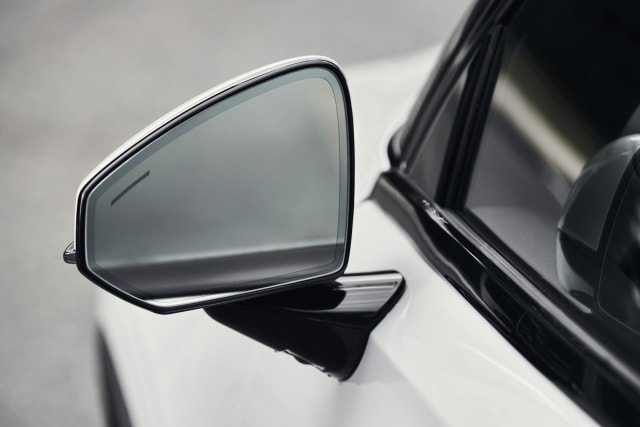
Your biggest concern will be making sure that the lane next to you is clear when you do try to pass because the Polestar 2’s blindspots are big enough to hide a MAC truck in. The A-pillars are broad, as are B-pillars. Plus, the side mirrors have been minimized to lower the drag coefficient, but they only give you a tiny peek at what’s in the lane next to you. I’d gladly take the reduced range if it meant I could get a better look at the traffic around me from larger mirrors.
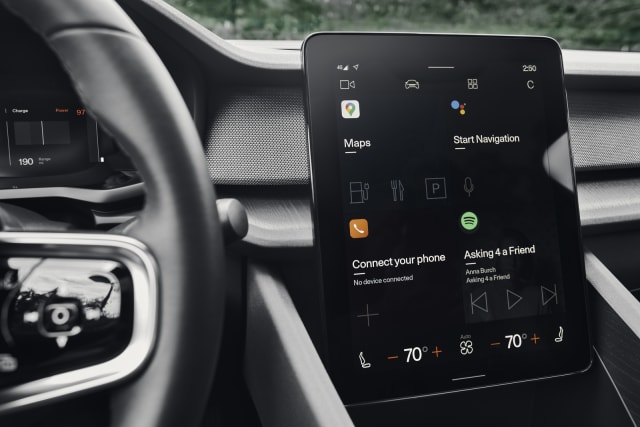
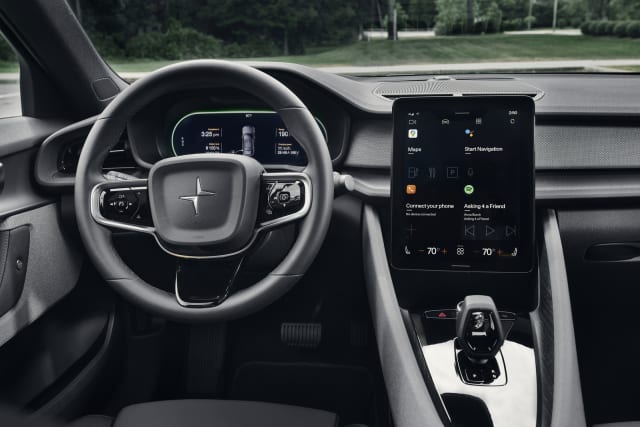
The centerpiece of the Polestar 2 is the vehicle’s fancy center console. It replaces virtually every knob, dial and switch with an 11-inch screen running one of the first versions of Android Automotive OS available to third-parties. Aside from the window and mirror controls, door locks and gear shift, everything is run through what looks like an iPad Pro set in portrait mode and crammed against the front of the dash. I’ve never been much of a fan of these sorts of controls. The idea of hunting through multiple sub-menus on a glorified tablet while navigating rush hour traffic has always given me the heebie-jeebies, but the AAOS system is remarkably straightforward and intuitive. I never tapped more than a couple times to get to the control I was looking for.
Polestar / Beadyeye
That’s not to say there isn’t a learning curve. I spent 10 sweltering minutes in 98 degrees weather trying to turn on the A/C for the first time but after that, the process took seconds. And to be fair, I could have just not been stubborn and said, “Hey Google, turn on the air conditioning and set the temperature to 68 degrees.” Because that works too and it’s pretty cool.
Typically when you pair your smartphone to your car’s infotainment system, it simply mirrors the phone’s functionality. AAOS, on the other hand, is a standalone system meaning you won’t have to physically plug your phone into it -- though you will need a Bluetooth connection to make calls and send texts.
Instead, you simply link the infotainment to your Google account. Doing so enables a deeper degree of integration, enabling drivers to use their preferred options when dealing with Maps for navigation, Google Play for media or Assistant for voice assist. What’s more, according to the Polestar press kit, if you’ve already own a Google Home, congrats, your Google account already has a bunch of recordings of your speech patterns so the infotainment system will more clearly understand you from the get-go.
“From a security perspective, similar things that we have on the phone are things that also exist in the vehicle,” Haris Ramic, Google product lead for Android Automotive, told Engadget. “So for example, you can go set it up, if you lock your account, it gets encrypted. And [to access that encrypted data] you have to either enter a PIN into the vehicle or sometimes to do something on the phone [such as 2-factor authentication] to open it up. When the vehicle does shut down, the user partitions, which is the area where all the user information is stored, also get encrypted.”
What’s more, Google is being cautious as to which companies are being allowed access to its fledgling OS’ APIs. “The goal is, obviously, not to focus just on big companies because innovation can come from anywhere. We don't want to provide a set of API's that anybody can use,” Ramic continued. “But partially the reason why we're going so slow is, rather than just opening up everything and saying anybody can develop anything they want, we're targeting areas where we know there's a lot of consumer value.”
Logging in to the infotainment system is not a requirement, mind you, it will work just fine without your credentials, just not with the same degree of personalization (and data privacy exposure) as if you did. During my test drive, I used a generic account provided by Polestar and paired my phone via Bluetooth. So while it wouldn’t play songs from my Google Music account, I still had easy access Maps, Assistant and Spotify.
Polestar / Beadyeye
Assistant was surprisingly effective and intelligent during the four-plus hours I had to play with it. I didn’t have to manually input any destinations, simply told Assistant where I wanted to go and the system automatically generated a route. This was way, way easier than the navigation experience we saw with the Cooper SE back in January. Assistant was generally unfazed by background noise, quickly responding over the sounds coming from the Polestar’s 16 speaker Harmon Kardon stereo system and really only got bogged down when trying to understand me while I shouted commands with the windows down at freeway speeds.
It did return a few incorrect results when I asked it to play specific bands. For example, when asked it to play The Coup, Spotify loaded up “In the Coupe” by Curren$y and Harry Fraud instead, or when I requested Chika, I got Chica. And yet somehow when I asked for Fear and Loathing in Las Vegas, the system correctly loaded “Return to Zero“ without hesitation. Whether that’s a shortcoming of Assistant’s ability to parse language or Spotify simply not having those artists in its catalog is something I couldn’t discern during the few hours I had the car. But it definitely made me long to have access to my existing Google Music playlists.
One issue I did run into was the fact that streaming media requires a 4G/LTE connection and when picking my way through the Santa Cruz hills, I often ran into service dead zones which would cut the music until the signal was restored (thankfully, it didn’t impact navigation.) This goes for streaming services like Google Music or Spotify as well as FM and AM radio stations (which are also streamed via an onboard app because AM radio signals play havoc with EVs.) Luckily you can easily get around this issue by making a hard connection between your phone and the system via one of four USB-C ports and playing media directly from the phone’s hard drive if you don’t want to chance it. The console also offers a 15w charging pad for induction-capable phones.
Volvo’s influence (as part-owner of the brand) is apparent in the vehicle’s broad array of safety and driver assist features. It will feature Level 2 ADAS, namely Pilot Assist (which is already being deployed in Volvo models like the V60 and the XC90) -- it provides acceleration, braking and steering up to 81 mph; blindspot, rear crash, and cross-traffic alerts; a lane-keeping aid, crash mitigation and avoidance. It even keeps an eye on the driver to make sure they’re staying focused on the road. That’s not to say it has cameras monitoring the driver or anything, the attention monitor is based on steering wheel contact. One unique safety feature of the Polestar 2 is its front inner-side airbags. These are mounted on either side of the center console and are designed to protect both driver and passenger from either shattering their femurs against the console or slamming into one another in the event that the vehicle gets hit from the side.
The car’s body is constructed from stamped steel with five paint options and a pair of interiors made from vegan materials, but if you want the Napa leather, it’s available for four grand extra. Why you’d spend that, I have no idea. The standard Weavetech seats are made from cork and recycled plastics (sans the phthalates which typically are used to increase material flexibility) and are very comfortable. The seat upholstery looks like leather but breathes like cotton -- even in triple-digit temperatures my backside remained dry.
Polestar is already working on three OTA updates for the coming months: a digital key similar to what we saw from Apple and BMW in July. That’s arriving later this year, as is a “connected safety” feature. Apple CarPlay compatibility should be ready by early 2021. If you’ve already got a preorder registered with Polestar, the first batch of vehicle deliveries should start arriving in September. Unfortunately, if you put down a deposit today, you’re looking at a December delivery date. Unusually spec’d orders (that is, color, interior and package combinations that not many people are asking for) are looking at a potentially similar time lag.
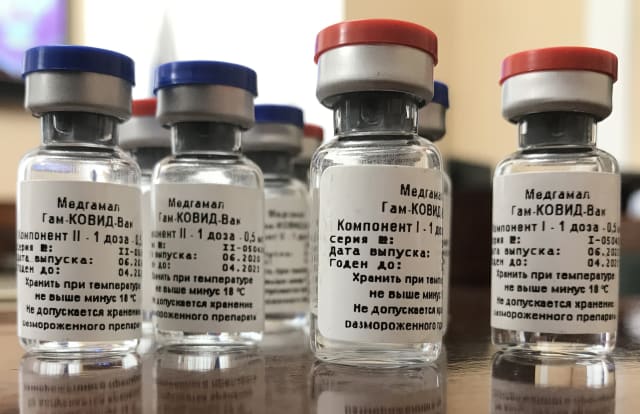
As nations and NGOs around the world scramble to develop a safe and effective vaccine against the coronavirus, Russia claimed on Tuesday to already have one. "A vaccine against coronavirus has been registered for the first time in the world this morning," Russian President Vladimir Putin said on state TV during a press conference outside his residence. "I know that it works quite effectively, it forms a stable immunity."
He is reportedly so confident of the vaccine’s efficacy that he has already inoculated one of his children with it. "One of my own daughters has tested the vaccine," Putin continued. "All she experienced was a slightly elevated temperature and [she] feels just fine." However, the breakneck speed at which the formula was developed — not to mention the monumental stakes at hand — has many medical researchers questioning whether Russia cut any corners in its efforts to be the first country with a viable vaccine.
The formula, dubbed Sputnik-V in honor of the first satellite to reach space in 1957, was developed by Moscow’s Gamaleya Institute. However, the Institute has not released any developmental or scientific data relating to the vaccine’s creation, nor has it undergone peer review, so all we have to go on is what the Russians have publicly announced. Without that data, the World Health Organization cannot evaluate the vaccine’s safety or efficacy, Jarbas Barbosa, the assistant director of the WHO’s regional branch, the Pan American Health Organization, explained to Al Jazeera.
Russian health officials have already noted that medical workers, teachers and other front-line groups will be among the first to receive the treatment when production ramps up in September. Putin plans to have doses ready for the general public come January but they won’t be the only ones to receive it. "We've seen considerable interest in the Russian vaccine developed by the Gamaleya Institute abroad. Moreover, we have received preliminary applications for over 1 billion doses of the vaccine from 20 countries," Kirill Dmitriev, head of the Russian Direct Investment Fund (RDIF), told CNN on Tuesday. A number of US companies are reportedly interested as well.
Now, while Putin said that the formula has been “registered,” that really only means that it’s gone through a bureaucratic process within the Russian Health Ministry -- akin to getting regulatory approval. What it has not completed is its Phase 3 clinical trial, a critical step in determining a drug’s safety for the general populace.
Rigorous, clinical trials got their start in the 18th century when physician James Lind conducted a study into the cause of scurvy amongst sailors on long distance voyages. These trials grew into their modern form in the 1920s and 1930s with the introduction of randomization, replication, and blocking. Today’s trials are typically conducted in a series of phases: Phase 0 involves around 10 - 15 people and is done to see the basic effects of the drug on the human body using very small doses of the formula. Phase 1 screens for safety with a group of around 20 - 80 people to ensure that the drug won’t immediately kill or incapacitate anyone. Phase 2 determines the most effective dosages of the drug and the proper dosage range.
Phase 3 trials allow drug developers to test the formula’s safety and efficacy, spot potential side effects or interactions with other common pharmaceuticals and compare it to existing treatments. They usually require months to complete, involve thousands to tens of thousands of people, and typically come before a drug gets registered. For example, Moderna’s mRNA-1273 Phase 3 trial, which began in July and which has just landed a major supply deal with the US government, will rely on as many as 30,000 volunteers.
“Although face coverings, physical distancing and proper isolation and quarantine of infected individuals and contacts can help us mitigate SARS-CoV-2 spread, we urgently need a safe and effective preventive vaccine to ultimately control this pandemic,” NIAID Director Dr. Anthony S. Fauci, said in a press release. “Results from early-stage clinical testing indicate the investigational mRNA-1273 vaccine is safe and immunogenic, supporting the initiation of a Phase 3 clinical trial. This scientifically rigorous, randomized, placebo-controlled trial is designed to determine if the vaccine can prevent COVID-19 and for how long such protection may last.”
Russia’s vaccine, on the other hand, is reportedly based on other members of the coronavirus family which can cause less severe colds and flus. Rather than wait for the results from tens of thousands of study cases, it appears that the Russians may have engaged in a form of intensive human challenge trial, starting with members of the research team themselves, then expanding to military service members and eventually the VIP cohort that Putin’s daughter was a part of.
Per the US National Library of Medicine, Sputnik-V’s Phase 1 and 2 trials involved a total of 76 people. Among the 38 who were administered either one or two doses of the actual vaccine, all produced antibodies. The effects of the vaccine were reportedly mild with elevated temperatures and headaches being the most reported symptoms.
“I hope that the Russians have actually definitively proven that the vaccine is safe and effective,” Fauci told ABC News correspondent Deborah Roberts this week, during the taping of an upcoming NatGeo keynote event. “I seriously doubt that they've done that.”
Human challenge trials are much more direct than the multiphase trials described above. These “are trials in which participants are intentionally challenged (whether or not they have been vaccinated) with an infectious disease organism,” the WHO explains in its 2016 publication, Human Challenge Trials for Vaccine Development: regulatory considerations. “This challenge organism may be close to wild-type and pathogenic, adapted and/or attenuated from wild-type with less or no pathogenicity, or genetically modified in some manner.”
The very first vaccine ever developed was done through a human challenge trial in 1796 when English physician Edward Jenner deliberately infected his son with cowpox, which causes a mild reaction in humans, to protect the boy from its much deadlier cousin, smallpox. The tradition continues today with organizations like 1DaySooner advocating for coronavirus human challenge trials. It has already signed up more than 25,000 volunteers. However this method is not without its dangers, especially in the case of COVID-19.
“Human challenge studies are generally contemplated only when rescue with a lifesaving treatment or intervention is available should a vaccine candidate not protect a volunteer from the disease,” Michael Rosenblatt, Chief Medical Officer for Flagship Pioneering, argues in a June StatNews op-ed. “But there is no cure or treatment against the SARS-CoV-2 virus that can be deployed with confidence, making viral challenges particularly risky and ethically questionable.”
He also points out that while vaccines for diseases like the measles and mumps are fully effective, some vaccines — especially for adults — can be only 70 to 80 percent effective and as little as nine percent. “Imagine, for a moment, that a vaccine candidate undergoing testing turns out to generate immunity in 80 percent of those who receive it. Then 20 percent will become infected with Covid-19,” he wrote.
Russia’s methodology has also drawn concern from the World Health Organization, which has requested that the Russian Federation adhere to international norms and regulations regarding vaccine development.
“It’s vital that we apply all public health measures that we know are working, and we need to continue to invest in and accelerate the development of safe and effective treatments and vaccines that will help us reduce disease transmission in the future,” WHO spokesman Tarik Jasarevic said during a Tuesday press conference.
“We are in close contact with the Russian health authorities, and discussions are going on with respect to possible pre-qualification of the vaccine," he continued. To date, the “WHO lists 25 candidate vaccines in clinical evaluation and 139 in a pre-clinical evaluation.”
The world passed 20 million global infections this week so if we have any hope of getting back to a pre-pandemic normal, we’re going to need at least a couple of those vaccine candidates to prove effective.
 Engadget
 Engadget
 Engadget
 Engadget
 Engadget